105 Years of Fast-Food History (1921–2026)

White Castle History: Origin, Founders & Timeline

White Castle was founded in March 1921 in Wichita, Kansas by Billy Ingram and Walter Anderson, creating America’s first fast-food hamburger chain. Beginning with $700 in capital and 5-cent square steam-grilled sliders that evolved into today's iconic White Castle menu, the company pioneered standardized commercial kitchens, porcelain castle architecture, and modern takeout dining.

Updated October 2026 • 9 min read • Audited by Fast-Food Historians
Scroll Down
Quick Facts

White Castle History: Quick Facts at a Glance

White Castle was founded in March 1921 in Wichita, Kansas, by Billy Ingram and Walter Anderson as America's first fast-food hamburger chain. Celebrating 105 years in 2026, the company remains 100% family-owned with 342+ locations across 15 states.

Key Fact: Before White Castle, hamburgers were widely viewed as unsafe street-cart food following Upton Sinclair's 1906 novel The Jungle. White Castle did not merely standardize fast-food operations — it redeemed the hamburger as a sanitary, respectable American dining staple.

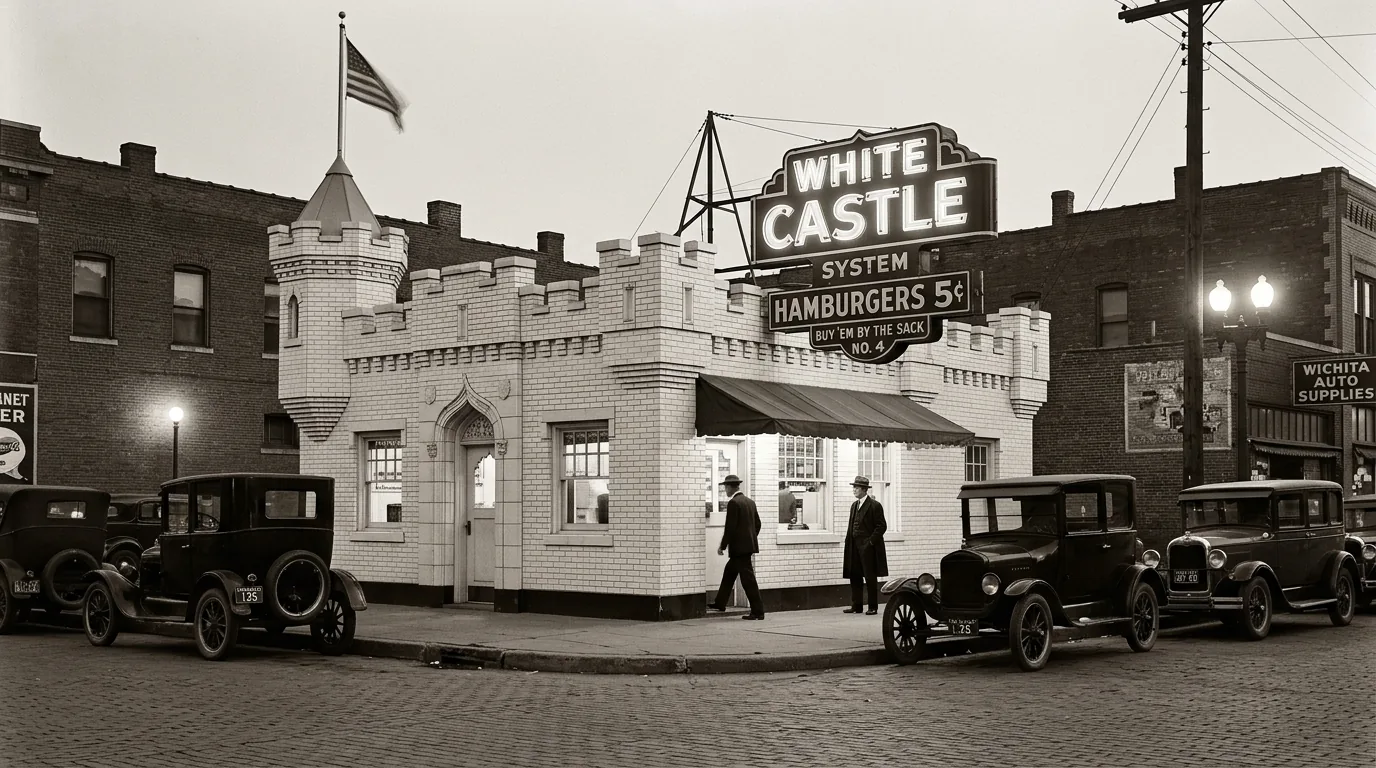
Historic White Castle No. 4 in Wichita, Kansas (1921): Gleaming white porcelain enamel brick building with medieval battlements, neon signs, and vintage 1920s cars
Archival Tribute: White Castle No. 4 at First & Main Streets in Wichita, Kansas (Established March 1921) The Birthplace of Commercial Fast Food
Founding Year & Age

March 1921 (105 Years)

Founded in Wichita, KS with $700 in capital, predating McDonald's by 19 years and Burger King by 33 years.

Original Slider Price

5 Cents ($0.05)

Sold for a nickel from March 1921 to 1929, making fresh, sanitary meals affordable to working families.

Ownership Model

100% Family-Owned

Privately held by the Ingram family for 105 consecutive years, operating with zero franchised units in the US.

White Castle Fast Facts & Key Details

Verified corporate data points, founding milestones, and company statistics:

Swipe horizontally to view full facts table Scroll →
Historical Fact Official Specification Historical Context
Founding Date March 1921 105 years in continuous operation as of 2026.
Origin Location Wichita, Kansas First & Main Streets (White Castle No. 4).
Co-Founders Walter Anderson & Billy Ingram Cook/inventor teamed with insurance/marketing executive.
Initial Capital $700 Borrowed Capital Repaid in full within 90 days from burger profits.
Original Slider Price $0.05 (5 Cents) Nickel pricing held from March 1921 through 1929.
Flagship Menu Item The Original Slider® 2x2-inch square 100% USDA beef patty on custom bakery bun.
Brand Name Meaning Cleanliness & Permanence 'White' for hygiene post-The Jungle; 'Castle' after Chicago Water Tower.
Corporate Headquarters Columbus, Ohio Relocated from Wichita, Kansas in 1934 for rail & highway logistics.
Ownership Structure 100% Private (Family-Owned) Continuous Ingram family ownership across 4 generations (Zero US franchises).
Current Leadership Lisa Ingram President and Chief Executive Officer (4th generation).
Corporate Mission Statement Memorable Moments "To create memorable moments every day."
Current Restaurant Count 342+ Company-Owned Locations Operating across 15 US states, plus nationwide grocery frozen slider distribution.
Origin Location

Where Did White Castle Originate?

White Castle originated in Wichita, Kansas, in March 1921. Co-founders Billy Ingram and Walter Anderson launched their first joint restaurant at the northwest corner of First and Main Streets, using $700 in borrowed capital to open White Castle No. 4.

Origin City & State Wichita, Kansas
Exact Street Corner First & Main Sts.
Store Designation Castle No. 4
Starting Capital $700 Borrowed

In 1921, Wichita was a booming Midwestern railroad hub and meat processing center. Anderson and Ingram recognized that factory workers and downtown commuters needed fast, hot meals they could trust. The northwest corner of First and Main Streets offered heavy pedestrian foot traffic from trolley lines, making it the ideal launchpad for the nationwide chain featured in today's locations directory.

Founding Date

When Did White Castle Open?

White Castle officially opened in March 1921 when Billy Ingram partnered with Walter Anderson in Wichita, Kansas. While Anderson operated an unbranded hamburger stand in 1916, White Castle as a corporate brand and chain began in 1921.

1916

Walter Anderson's Unbranded Stands

In 1916, fry cook Walter Anderson opened an independent, unbranded hamburger stand in a converted shoe-repair shop in Wichita, Kansas. He flattened fresh ground beef meatballs on a scorching griddle, topped them with shredded onions, and placed buns directly on top to absorb vapor—a technique cravers still replicate today with homemade copycat slider recipes. While this proved the culinary format worked, it was a solo venture with no chain infrastructure or corporate name.

1921

Official Birth of White Castle

The White Castle brand itself was born in March 1921 when Anderson partnered with real estate and insurance executive Edgar Waldo "Billy" Ingram. Ingram supplied $700 in capital, conceived the "White Castle" brand identity, and co-founded White Castle No. 4. That is why 1921 is universally recognized by the Library of Congress, culinary historians, and White Castle itself as the official founding date.

Co-Founders

Who Founded White Castle?

Walter Anderson and Edgar Waldo "Billy" Ingram co-founded White Castle in March 1921 with $700 in borrowed capital. Anderson was a short-order cook who invented the steam-griddle smash method, while Ingram was an insurance businessman who created the brand.

WA

Walter A. Anderson

The Culinary Cook & Inventor (1880–1963)

Walter Anderson worked as a streetcar conductor and fry cook in Wichita food stalls before launching his own hamburger stands in 1916. Frustrated with traditional thick meatballs that took too long to cook, Anderson pioneered the method of smashing ground beef thin with a custom heavy spatula and searing it directly over minced onions.

  • • Key Innovation: Smashed flat-patty steam-griddle technique.
  • • Role: Kitchen operations, recipe formulation, equipment design.
  • • Legacy: The signature steam-grill method that anchors the modern slider menu at every Castle today.
BI

Edgar Waldo "Billy" Ingram

The Brand Strategist & Builder (1880–1966)

Born in Leadville, Colorado, in 1880, Billy Ingram worked in insurance and commercial real estate in Wichita. He met Anderson through the local Rotary Club and recognized the untapped potential of Anderson's popular diner counters. Ingram brought the business acumen, marketing psychology, financial discipline, and national vision required to build a multi-state restaurant chain.

  • • Key Innovation: The "White Castle" brand name, Paperlynen caps, Porcelco buildings.
  • • Role: Financing, real estate acquisition, national branding, supply chain.
  • • Legacy: Built the 4-generation Ingram family enterprise that still owns the company.
Name Meaning

Why Is White Castle Called White Castle?

Billy Ingram named White Castle to conquer public distrust following Upton Sinclair's 1906 novel The Jungle. "White" symbolized clinical cleanliness and food hygiene, while "Castle" signified architectural permanence, modeled directly after the Chicago Water Tower.

Overcoming Upton Sinclair's 1906 Novel, The Jungle

In 1906, author Upton Sinclair published The Jungle, a shocking exposé revealing unsanitary conditions inside Chicago meatpacking plants. For the next two decades, the American public regarded commercially prepared ground beef with deep suspicion, viewing hamburger stands as contaminated food for the desperate.

⚪

"White" Signified Absolute Cleanliness

Ingram selected "White" to communicate purity, hygiene, and clinical sanitation. Restaurants featured gleaming white porcelain-enamel exteriors, stainless steel surfaces, spotless white tile walls, and cooks wearing starched white aprons and hats to assure customers that their food was prepared with inspected 100% beef ingredients.

🏰

"Castle" Signified Strength & Permanence

Ingram selected "Castle" to evoke architectural permanence, stability, and enduring institution. The physical buildings were modeled directly after the historic Chicago Water Tower, featuring Gothic Revival turrets, crenelated roof battlements, and arched entranceways.

Original Restaurant

Is the First White Castle Still Open?

No, the original White Castle building at First and Main Streets in Wichita, Kansas, is not open. The five-stool structure was demolished decades ago; the corner is now occupied by an Intrust Bank branch marked by an official Kansas Historical Society plaque.

The Fate of Castle No. 4 and Kansas Operations

White Castle No. 4 operated as a tiny, five-stool lunch counter that served fresh sliders for five cents each, inspiring the chain's commemorative thick-patty 1921 Slider. As the chain rapidly expanded with larger prefabricated modular buildings throughout the Midwest, the humble original stand was retired and eventually demolished.

By 1938, White Castle closed its final restaurant in Wichita after relocating its corporate headquarters to Columbus, Ohio. Today, White Castle operates zero physical restaurants in the state of Kansas. However, the northwest corner of First and Main Streets features an official Kansas State Historical Society bronze plaque honoring the site as the birthplace of the worldwide fast-food industry.

1933 Transition

What Happened to Walter Anderson?

Walter Anderson retired from White Castle in 1933 during the Great Depression, selling his 50% ownership stake to Billy Ingram for cash. Following the buyout, Ingram moved corporate headquarters to Columbus, Ohio in 1934 to access major transportation networks.

In 1933, during the depths of the Great Depression, Walter Anderson decided to retire from active restaurant operations and sold his entire 50% ownership stake to Billy Ingram for a substantial cash payout. Anderson withdrew from the corporate restaurant sphere to pursue private interests and aviation, leaving Ingram as sole owner and president.

Following the buyout, Ingram made the strategic decision in 1934 to move White Castle's corporate headquarters from Wichita, Kansas, to Columbus, Ohio. Columbus offered central access to major rail lines, emerging Midwest highway networks, and key manufacturing centers in Ohio, Illinois, Indiana, Michigan, and New York. By 1938, White Castle closed its final Wichita location, fully completing its transition into a Columbus-based national enterprise.

Industry Inventions

What Inventions Did White Castle Introduce to Fast Food?

White Castle invented foundational fast-food systems including standardized assembly-line prep, commercial carry-out sacks ("Buy 'em by the sack"), disposable Paperlynen chef hats, the 1954 5-hole steam-cooking patent (#2,670,296), 30-slider Crave Cases, and grocery retail frozen sliders.

Swipe horizontally to view all innovations Scroll →
Innovation Era / Year What It Was Industry Impact
Standardized Kitchen Operations 1920s Identical recipes, prep protocols, spatulas, and uniform restaurant architecture across every location to ensure product consistency. Created the foundational operating model for the entire global fast-food franchising and chain industry.
Carry-Out Sacks ("Buy 'Em by the Sack") 1920s–1930s Pioneered fast-food takeout dining by engineering heat-retaining paper bags and marketing bulk family orders. Transformed hamburgers from an individual lunch-counter snack into a shareable home meal.
Prefabricated Enamel Buildings (Porcelco) 1928–1934 Constructed modular white porcelain enamel steel buildings through subsidiary Porcelco for rapid store assembly. Established the gleaming white castle visual brand and allowed fast expansion across Midwest cities.
Adjustable Paper Caps (Paperlynen) 1931 Invented disposable paper chef hats so staff always wore sanitary headwear without laundering cloth caps. Spawned the Paperlynen subsidiary, producing over 42 million disposable paper caps annually worldwide.
Bulk Multi-Pack Sack Ordering & Crave Cases 1930s / 1987 Shifted ordering psychology to 10-sacks, and in 1987 launched the iconic 30-slider cardboard Crave Case. Became a staple of American late-night culture, sports tailgates, and pop-culture cinema.
5-Hole Steam Patty Patent 1949–1954 Conceived by employee Earl Howell (1949) and patented in 1954 (US Patent #2,670,296), punching 5 holes in every beef square. Eliminated the need to flip burgers on the grill while simultaneously infusing onion steam into the bun.
Drive-Thru Window Rollout 1980 Officially integrated speaker-box drive-thru windows across its company-owned store network. Modernized ordering throughput as car-based suburban dining surged across the United States.
Retail Frozen Food Division 1987 Began flash-freezing and packaging sliders in company bakeries and meat plants for grocery store distribution nationwide. Expanded the brand's reach to all 50 states, generating over 20% of total company revenue.
Trademark Precedent

How White Castle Protected Its Brand from Imitators

White Castle's success spawned copycat chains like White Tower, Krystal, Royal Castle, and Little Tavern. In 1929, White Castle sued White Tower, winning a landmark 1931 federal unfair competition ruling that established foundational intellectual property precedent in American dining.

The Landmark 1929–1931 White Tower Federal Lawsuit

Founded in Milwaukee in 1926 by John E. Saxe and his son Thomas, White Tower copied White Castle down to its white enamel turrets, slogan ("Buy a Bag of Folks"), and 5-cent square burgers. White Castle filed a federal unfair competition lawsuit in 1929. In a landmark 1931 ruling upheld by the US Court of Appeals in 1932, the court ruled in favor of White Castle, forcing White Tower to pay damages, alter its building designs, and stop using confusingly similar slogans.

Imitator Chain Year & Origin Naming / Design Pattern Modern Status
Krystal 1932 (Chattanooga, TN) Square slider format with steamed onions; added yellow mustard as default. Active (280+ stores across Deep South)
White Tower 1926 (Milwaukee, WI) Copied white castle architecture, font, and 5¢ burger concept near-identically. Defunct (Sued by White Castle in 1929; lost landmark 1931 IP lawsuit)
Royal Castle 1938 (Miami, FL) Swapped 'White' for 'Royal'; served small square burgers and Birch Beer. Nearly extinct (Single independent diner remaining in Miami, FL)
Little Tavern 1927 (Louisville, KY) Swapped 'Castle' for 'Tavern'; marketed 'Buy 'em by the bag' sliders. Defunct (Closed final location in 2008)
Blue Bell / Blue Castle 1930s (Midwest) Swapped both name elements; mimicked white porcelain building turrets. Defunct
Red Barn 1961 (Springfield, OH) Distinct rustic branding, but adopted standardized quick-prep fast-food architecture. Defunct (Phased out in late 1980s)

While federal courts halted White Tower's direct architectural mimicry, the 1932 founding of Krystal created American fast food's longest-running regional slider rivalry. White Castle retained dominance across the Midwest and Northeast, while Krystal established a cultural stronghold across the American South.

Ownership

Who Owns White Castle Today?

White Castle is 100% privately owned by the descendants of co-founder Billy Ingram across four generations, currently led by President and CEO Lisa Ingram. The family operates 342+ company-owned restaurants across 15 states with zero franchised units in the United States.

4 Generations of Ingram Family Leadership

White Castle has remained 100% privately owned by the Ingram family for over 105 consecutive years (March 1921–2026). Current President and CEO Lisa Ingram represents the fourth generation of the family to lead the enterprise, succeeding her father E.W. "Bill" Ingram III and grandfather E.W. Ingram Jr.

Because White Castle refuses to franchise in the US, every restaurant is company-owned, allowing strict control over product quality, employee benefits, and long-term culinary investments.

342+ Castles Across 15 States

As of 2026, White Castle operates 342+ restaurants across 15 states, anchored in core Midwest metro areas (Chicago, Columbus, Indianapolis, Detroit, Louisville, St. Louis, Twin Cities) and the New York / New Jersey metropolitan corridor.

Recent strategic expansions brought high-volume destination flagships to the Las Vegas Strip (2015), Scottsdale & Phoenix, Arizona (2019–2024), and Orlando, Florida (2021), home to the world's largest free-standing White Castle.

Corporate Mission

What Is White Castle's Mission Statement?

White Castle's official corporate mission statement is "To create memorable moments every day." The company centers this philosophy on long-term employee retention, family-owned operational stability, and multi-generational customer engagement across all 342+ restaurants.

Official Philosophy

The White Castle Purpose

"To create memorable moments every day."

White Castle's modern mission statement reflects a corporate culture built around internal employee longevity (including its honored "25-Year Club"), private family governance, and customer community traditions like the Cravers Hall of Fame, the Craver Nation Rewards program, and annual Valentine's Day fine-dining events.

Chronological Milestones

White Castle History Timeline: 1916 to 2026

Spanning 1916 to 2026, White Castle evolved from a single Wichita hamburger stand into an American cultural institution. Key milestones include the 1921 founding, 1934 Columbus move, 1954 steam-hole patent, 1987 grocery launch, and 2021 Centennial celebration.

Year Historical Milestone & Event
1916 Walter Anderson opens his first unbranded hamburger stand in Wichita, Kansas, using a griddle-smashed patty technique.
1921 Anderson partners with Edgar Waldo 'Billy' Ingram with $700 capital; White Castle No. 4 opens at First and Main Streets in Wichita in March.
1924 The business officially incorporates as the White Castle System of Eating Houses Corporation.
1928 Ingram forms the Porcelco subsidiary to engineer standardized, movable white porcelain enamel steel castle buildings.
1931 Ingram invents the adjustable paper cap and launches the Paperlynen subsidiary to supply hygienic headwear worldwide.
1933 Walter Anderson sells his entire ownership stake to Billy Ingram, leaving Ingram as sole owner.
1934 Corporate headquarters permanently relocates from Wichita, Kansas, to Columbus, Ohio for rail and highway supply lines.
1938 White Castle closes its last remaining restaurant in Wichita, completely exiting its founding state of Kansas.
1942–1945 World War II beef and sugar rationing forces strict operational conservation and temporary menu adjustments.
1949 Employee Earl Howell suggests punching five holes in the patty; patented in 1954 (US Patent #2,670,296) for steam-grilling without flipping.
1980 White Castle officially rolls out drive-thru service windows across its restaurant network.
1987 White Castle launches both the 30-slider Crave Case packaging and its nationwide retail Frozen Slider grocery division.
2014 Time Magazine names the White Castle slider 'The Most Influential Burger of All Time'.
2015 White Castle expands West, opening its legendary first Las Vegas Strip location to record-breaking lines.
2019 White Castle enters Arizona with its flagship Scottsdale restaurant, subsequently expanding to 4 Southwest locations.
2021 White Castle celebrates its 100th Centennial Anniversary, debuts the thick-seared '1921 Slider', and opens the world's largest Castle in Orlando, Florida.
2026 The Ingram family celebrates 105 years of continuous private ownership, operating 342+ company-owned restaurants across 15 states.
Historical FAQs

Frequently Asked Questions About White Castle History

Direct, verified answers to common historical questions regarding White Castle's founding, corporate patents, ownership structure, and legacy. Every Boolean inquiry begins with a definitive Yes or No followed by factual context.

Did White Castle invent the hamburger?

No. Ground beef patties between bread existed at American county fairs before 1921, but White Castle invented the commercial fast-food hamburger chain, the standardized steam-griddle smash method, and the first custom square bakery bun.

Is White Castle the oldest fast-food hamburger chain in the world?

Yes. Founded in March 1921 in Wichita, Kansas, White Castle is recognized by culinary historians and the Library of Congress as the world's first fast-food hamburger chain, predating competitors like Krystal (1932), McDonald's (1940), and Burger King (1954).

Is the first White Castle restaurant in Wichita still open?

No. The original five-stool building at First and Main Streets in Wichita was demolished decades ago; the site is now occupied by an Intrust Bank branch and marked by an official Kansas State Historical Society bronze commemorative plaque.

Can you purchase a White Castle franchise in the United States?

No. White Castle has never sold franchise licenses in the United States. Every one of its 342+ restaurants, bakeries, and meat processing facilities is 100% owned and operated directly by the private Ingram family company.

Does White Castle have an official corporate mission statement?

Yes. White Castle's official corporate mission statement is 'To create memorable moments every day.' This philosophy guides company operations, employee retention programs, and customer community engagement across all 342+ stores.

Did White Castle open before McDonald's and Burger King?

Yes. White Castle opened in March 1921, operating for 19 years before Richard and Maurice McDonald opened their first barbecue stand in San Bernardino in 1940, and 33 years before Burger King was founded in Miami in 1954.

Did White Castle invent the disposable paper chef's hat?

Yes. In 1931, Billy Ingram invented the adjustable paper hat so workers did not have to launder cloth caps. The innovation led White Castle to establish the Paperlynen subsidiary, which sold over 42 million paper hats worldwide annually.

Did White Castle win a landmark trademark lawsuit against White Tower?

Yes. White Castle took copycat chain White Tower to federal court in 1929 for copying its architectural design, slogan, and menu, winning a landmark 1931 unfair competition ruling that established foundational intellectual property protections in the US restaurant industry.

Does White Castle still operate restaurants in Kansas where it started?

No. White Castle closed its last remaining Wichita location in 1938 after moving its corporate headquarters to Columbus, Ohio in 1934, and currently operates no physical restaurant locations within the state of Kansas.

Were White Castle sliders originally sold for five cents?

Yes. From March 1921 until 1929, White Castle sliders were sold for exactly five cents (a nickel) each. The price rose to 10 cents during post-WWII inflation in 1949 before gradual modern menu adjustments.

Is White Castle still owned by the founder's family?

Yes. White Castle is 100% privately owned by the descendants of co-founder Billy Ingram across four generations, currently led by President and CEO Lisa Ingram with zero private equity or stock market shareholders.

How old is White Castle today?

105 years old. White Castle is 105 years old in 2026, operating continuously since its founding in March 1921. It is the longest-running fast-food chain in American history.
White Castle AI Engine

AI Dish Picker

Select your flavor mood and hunger level to calculate your ideal meal.